I'd replace the opening with: Managing multiple care services brings a different level of complexity…
From Paper to Digital Home Care Softwares
You run a care service.
Maybe it started small. A few clients, a small team, a rota that lived on paper or in a spreadsheet.
And at the beginning, it worked.
You knew where everything was. Your team knew what they were doing. It felt manageable.
But as your service grew, things became more complicated.
More staff. More clients. More moving parts.
And suddenly, the systems that once worked started slowing you down.
When everything is in different places
Your rota is on paper.
Care plans are in folders.
Staff records are somewhere else.
Compliance checks live in spreadsheets.
Notes are handwritten, sometimes rushed, sometimes hard to read.
You are not just running a service. You are constantly switching between systems, chasing updates, and trying to keep everything aligned.
And when something goes wrong, it is hard to track issues or understand where the problem started.
This is one of the biggest challenges in paper to digital home care transitions.
It is not just about paper. It is about disconnected information across different systems.
In fact, while digital adoption is increasing, nearly 3 in 10 social care providers were still using paper-based records for care plans and daily recordings in late 2024
👉 https://www.local.gov.uk/our-support/partners-care-and-health/digital-transformation/implementing-digital-social-care
As services grow, especially in domiciliary care, this becomes even harder to manage. Coordinating staff across the community, managing visits, and keeping communication consistent requires systems that can keep up.
Many providers reach a point where they begin looking for solutions designed specifically for home care environments.
👉 https://carecontrolsystems.co.uk/find-your-solution/domiciliary-care/
Trying to keep up
You try to fix it.
You add more structure. More spreadsheets. More processes.
You rely on experienced staff to hold everything together.
But the pressure does not go away.
Coordinators are constantly managing changes.
Managers do not always have a clear view across services.
Carers are writing notes at speed, sometimes worrying if they have written enough or written it correctly.
And all of this creates constant pressure.
You are still relying on manual updates, still chasing information, still dealing with the same problems.
And all of this takes time.
A lot of time.
The UK Government estimates that digitising care records could save around 30 million admin hours every year across adult social care, equating to at least 20 minutes saved per care worker, per shift.
Time that could be spent supporting people.
Time that could be spent supporting your team.
Stepping into a digital system
So you start exploring digital transformation in the care sector.
At first, it feels like a big shift.
You are not just replacing paper. You are changing how your service works.
There are questions.
Will the team use it
Will it slow things down at first
Will it actually make a difference
So you take a look.
And when you introduce a digital care management system, it does take some getting used to.
Logging in instead of picking up paper. Entering notes digitally. Viewing rotas on a screen.
It is different.
But it is also where the sector is heading.
Today, around 80% of adult social care providers now use digital social care records, covering over 90% of people receiving care according to NHS England.
Everything starts to come together
At some point, things start to click.
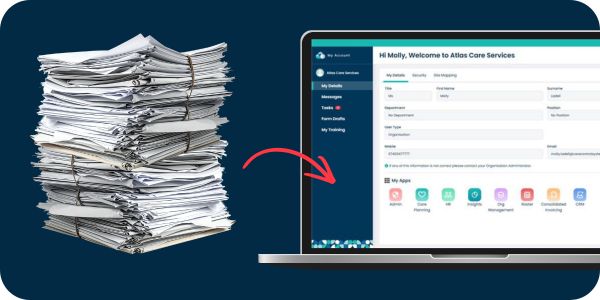
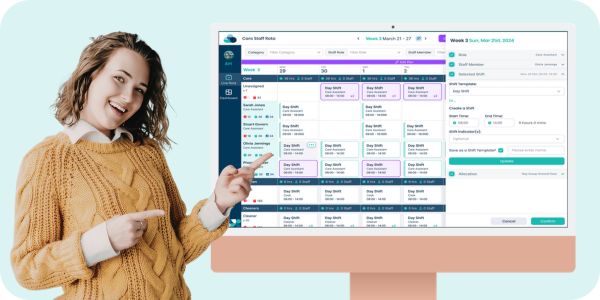
Your rota is no longer separate. It sits alongside your care planning.
Your care notes are no longer handwritten. They are recorded clearly, in real time.
Your admin tasks, HR records, and organisation management are all in one place.
Instead of switching between systems, you have one connected system.
This is where an all in one system starts to make a real difference.
Providers like Keane Premier Group, who operate across multiple services including care at home, have already experienced this shift. Managing different services through disconnected systems becomes increasingly difficult. Bringing everything together into one platform gives them visibility, consistency, and control across their organisation.
Not because it replaces paper.
Because it connects your entire service through real time information with no duplication.
What it looks like day to day.
Care planning becomes clearer and easier to update.
In fact, digital systems are proven to speed this up significantly. Care plans can be completed and signed off in 3 days instead of 7, and reviews can take 30 minutes instead of 4 hours when using digital records.
Changes are reflected instantly, so your team always has the most up to date information.
Your live roster means staff see changes as they happen.
Instant notifications alert managers when something needs attention, rather than relying on someone noticing it later.
If you are running multiple services, you can view everything in one place. A true multi site view that gives you oversight without needing to chase information.
This is especially important for organisations delivering domiciliary care, supported living, and residential care, where each service has different demands but still needs central visibility.
Your insights and reporting are no longer something you pull together manually. They are already there, giving you real time insights into your service.
And your HR and admin processes become part of the same system, not something separate you have to manage.
Giving time back to your team
One of the biggest changes is time.
When systems are disconnected, everything takes longer.
Writing notes
Checking rotas
Updating records
Preparing for inspections
With a home care software UK solution, these tasks become quicker and more consistent.
The Care Quality Commission highlights that digital systems make it easier to capture information at the point of care, respond more quickly to people’s needs, and reduce risks to safety. And that time goes somewhere.
Back to your carers
Back to your managers
Back to the people you support
Instead of spending time on paperwork, your team can focus on what matters.
Less admin. More time for care.
Supporting every member of your team
Digital systems also support your team in ways paper never could.
Around 1 in 10 people in the UK have some degree of dyslexia, and this number is often higher in health and social care settings.
That means a significant part of your workforce may find writing, spelling, or processing written information more challenging.
With digital tools, this changes.
Voice to text allows carers to record notes more naturally.
Spell check and smart suggestions help improve confidence in documentation.
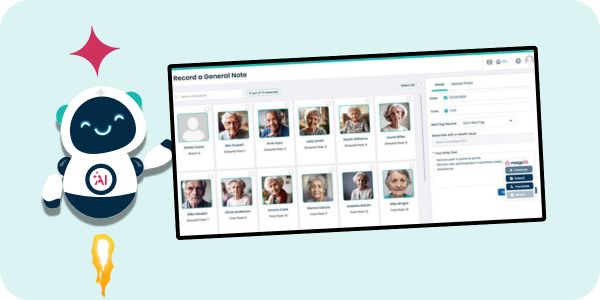
AI support can enhance notes, helping carers structure and improve what they have written.
Translation tools allow staff to use their own language and convert it into clear records.
This is not just about efficiency.
It is about inclusion.
It builds confidence in notes and supports every member of your team.
Stronger compliance & inspection readiness
Compliance is always there in the background.
CQC inspections. Audits. Evidence of care delivery.
With paper systems, preparing for this can be stressful and time consuming.
With digital systems, the information is already there.
And that matters more than ever.
As of 2025, only 2% of care homes are rated Outstanding, while 29% require improvement and 4% are rated inadequate under the latest framework.
Strong systems, clear records, and visibility play a huge role in improving outcomes.
Secure records are stored safely.
Updates are tracked.
A clear audit trail shows exactly what has happened and when.
This makes services inspection ready at any time, while also ensuring your organisation is protected.
NOT JUST for domiciliary care!
While this journey often starts in domiciliary care, the impact is felt across all services.
In residential care, it improves visibility across shifts and teams.
In supported living, it strengthens communication and consistency.
In extra care, it helps manage complex schedules and client needs.
The challenges may look slightly different, but the solution is the same.
Connected, real time, digital systems.
Getting things running smoothly.
Most services do not realise how much effort goes into holding everything together until they no longer have to.
At first, you are just managing.
Then things start to feel easier.
More organised
More visible
More controlled
And eventually, you reach a point where your system is supporting you, not slowing you down.
That is the real shift.
From juggling systems
To running one connected system
From reacting
To having more control
From struggling
To running smoothly
And once you reach that point, there is no going back.
Related Posts