Care technology has come a long way. Across the sector, digital systems are helping providers…
Ready to Consolidate your Care Management Software?

But Why Are Care Providers Consolidating Their Software
Care management software has transformed how care providers deliver, monitor and manage care across their organisations. From digital care planning and medication management to workforce scheduling and HR processes, modern care management software plays a vital role in supporting safe, efficient and compliant care.
Yet despite this progress, many providers still find themselves using multiple disconnected systems to manage different areas of their organisation.
It isn’t uncommon for a care provider to use dedicated Care Planning Software, separate HR Software, standalone rota management tools and additional systems for audits, compliance or medication administration.
While each system may solve a specific problem, many providers are discovering that managing multiple platforms can create challenges of its own.
As a result, organisations across residential care, nursing care, supported living and domiciliary care are increasingly moving towards all-in-one care management software that brings everything together in one place.
Why the Approach Is Changing
Historically, care providers adopted software one challenge at a time.
A digital care planning system replaced paper records. A rota platform helped manage staffing. An HR solution supported recruitment and compliance. Additional systems followed as services grew and operational demands increased.
At the time, each investment made sense.
However, over time many organisations found themselves managing multiple suppliers, multiple contracts, multiple logins and multiple sources of information.
What started as digital transformation gradually became digital fragmentation.
Information became spread across different systems, reporting became more complicated and teams found themselves switching between applications just to complete everyday tasks.
This is why more providers are now reviewing whether maintaining several disconnected systems is helping them work more efficiently, or creating unnecessary complexity.
The Demand for Better Oversight
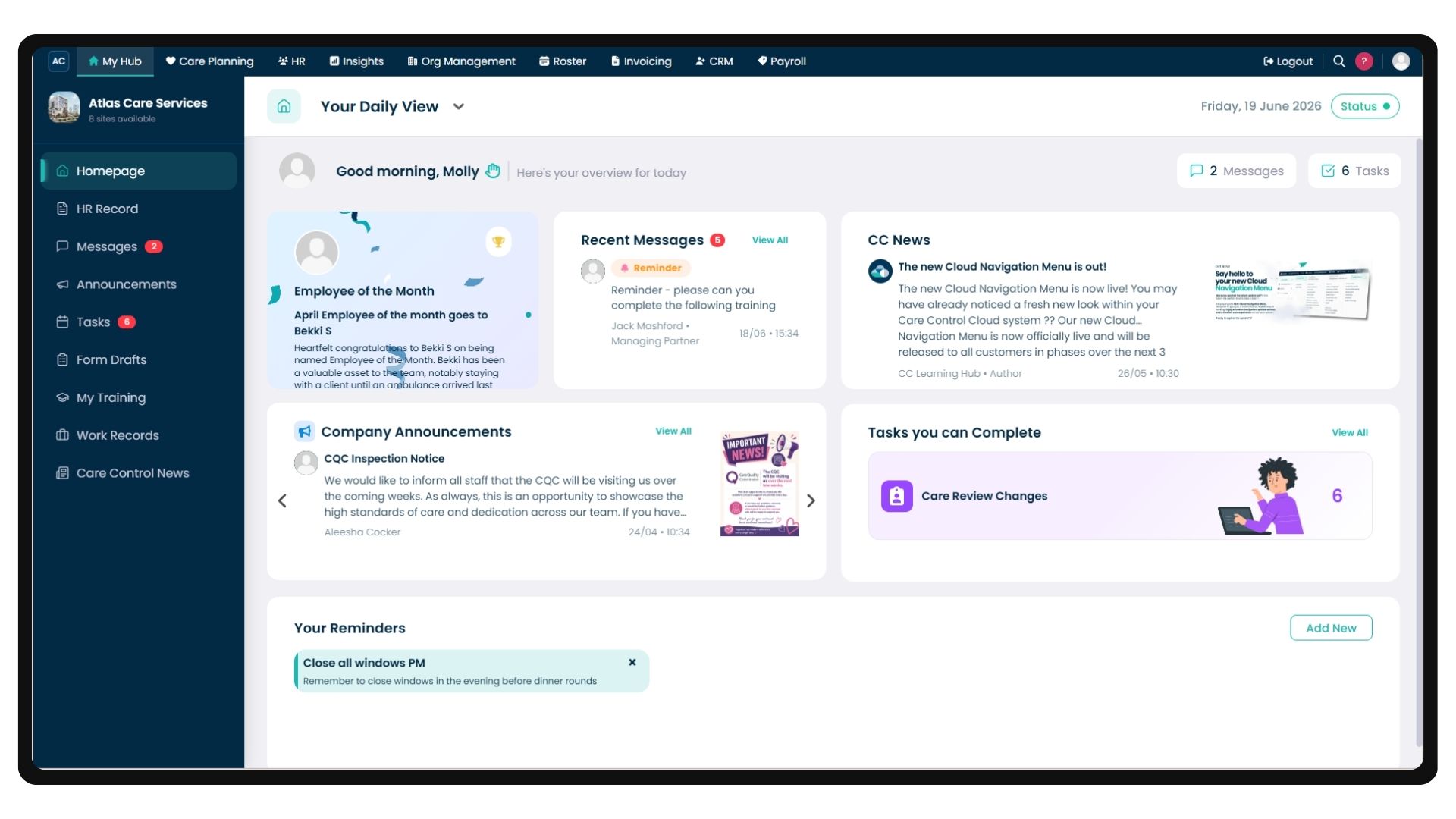
One of the biggest drivers behind software consolidation is the need for better oversight.
Care providers need accurate, up-to-date information to make decisions about staffing, compliance, quality assurance and service delivery.
When information is spread across multiple platforms, gaining a complete picture of organisational performance can become difficult.
Managers may need to move between care records, HR systems, audits and Rota Management Software simply to answer operational questions.
How many staff have mandatory training due?
Are there any gaps in rota coverage next week?
What actions are outstanding from recent audits?
Are there emerging trends that require attention?
When data exists across multiple systems, finding these answers often takes longer than it should.
An all-in-one care management platform creates a single source of truth, bringing operational information together in one place.
This allows managers to spend less time gathering information and more time supporting their teams and improving outcomes.
Reducing Administration Across the Organisation
If there’s one thing most registered managers would like more of, it’s time.
Administrative workload remains one of the biggest pressures facing care services today.
Staff and managers often spend hours each week updating records, maintaining multiple systems and re-entering information that already exists elsewhere.
Employee details may need updating in more than one platform. Staff availability sits in one system while compliance records sit in another. Reports often require information to be manually gathered from several different sources.
For domiciliary care providers using separate scheduling platforms, the challenge can be even greater, with information often spread between care records and domiciliary care rota software.
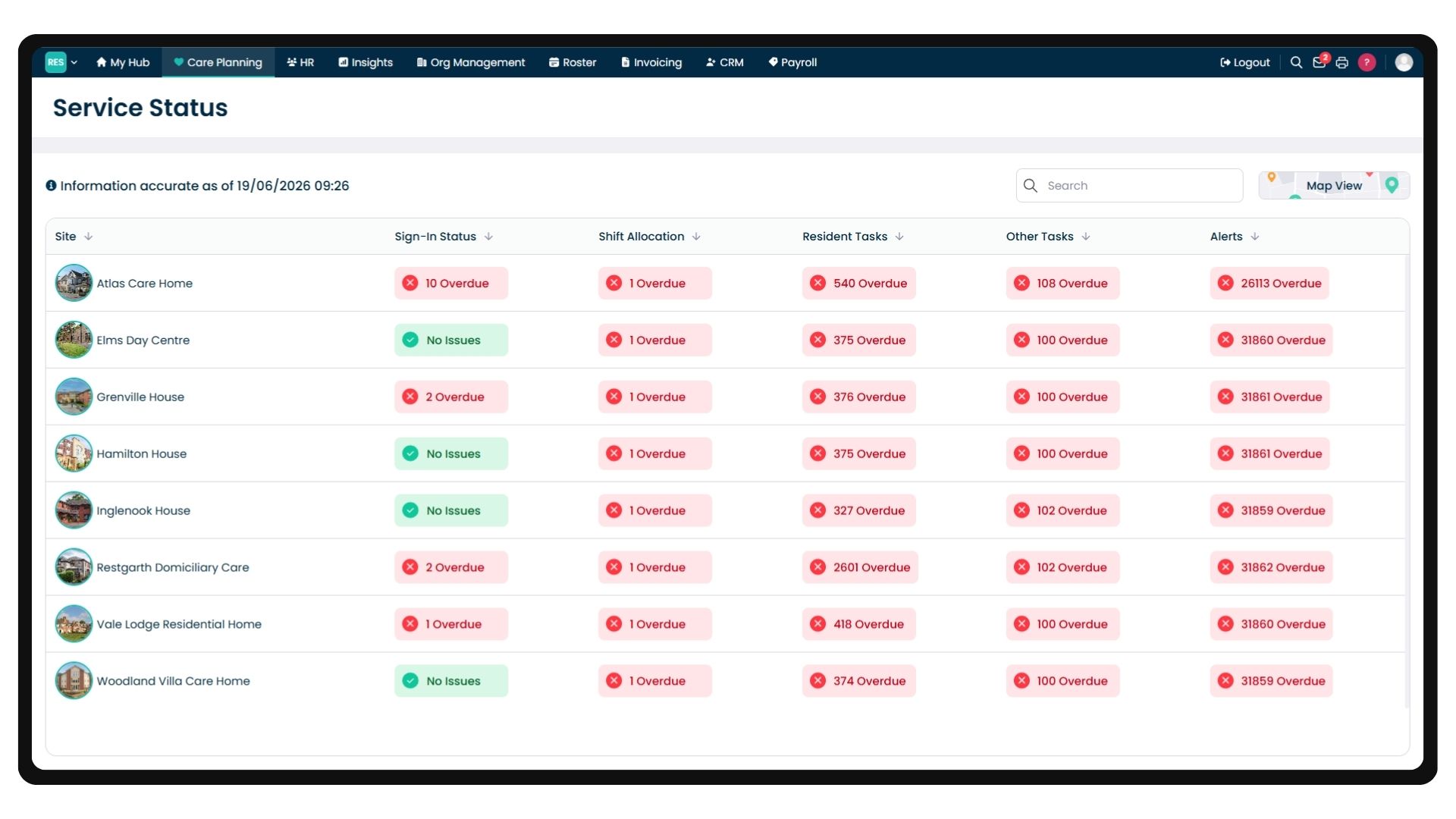
An integrated care management system helps reduce this duplication by allowing information to flow through a single platform.
The result is less administration, fewer opportunities for error and more time spent focusing on the people who matter most.
Supporting Compliance and Governance
Regulatory expectations continue to evolve, placing greater emphasis on evidence, accountability and governance.
Providers need confidence that they can quickly access accurate information when preparing for inspections, audits or internal reviews.
Disconnected systems can make this process more difficult than it needs to be.
When records are stored across multiple platforms, gathering evidence often requires additional time and effort.
All-in-one care management software helps centralise information, creating connected records that are easier to access, monitor and review.
This supports stronger governance while giving managers greater confidence in the quality, accuracy and consistency of their data.
Most importantly, it helps providers spend less time preparing information and more time acting on it.
Creating a Better Experience for Staff
Technology should make life easier for care teams, not more complicated.
When staff need to remember multiple passwords, navigate different systems and learn several platforms, adoption can become a challenge.
This is particularly important during onboarding, where new starters are already learning policies, procedures and ways of working.
A connected platform simplifies the experience by reducing the number of systems staff interact with every day.
The result is often faster adoption, reduced training requirements and greater confidence when using digital tools.
When technology feels simple and intuitive, teams are far more likely to engage with it consistently.
Real Providers Are Already Seeing the Benefits
The move towards all-in-one software isn’t simply a technology trend.
Across the care sector, providers are already experiencing the operational benefits that come from having connected systems and better visibility.
For example, Best Lives used Care Control to improve oversight and streamline processes across their services.
Similarly, Persona Care & Support highlighted how having a connected platform helped simplify operations across supported living and home care environments.
While every organisation’s journey is different, the message is often the same.
When information is connected, teams work more efficiently, managers gain better oversight and providers are able to make decisions with greater confidence.
Improving Decision Making Through Connected Data
Data plays an increasingly important role in modern care services.
Providers use information to identify trends, improve outcomes, manage risk and make informed operational decisions.
The challenge is that data becomes less valuable when it’s spread across multiple disconnected systems.
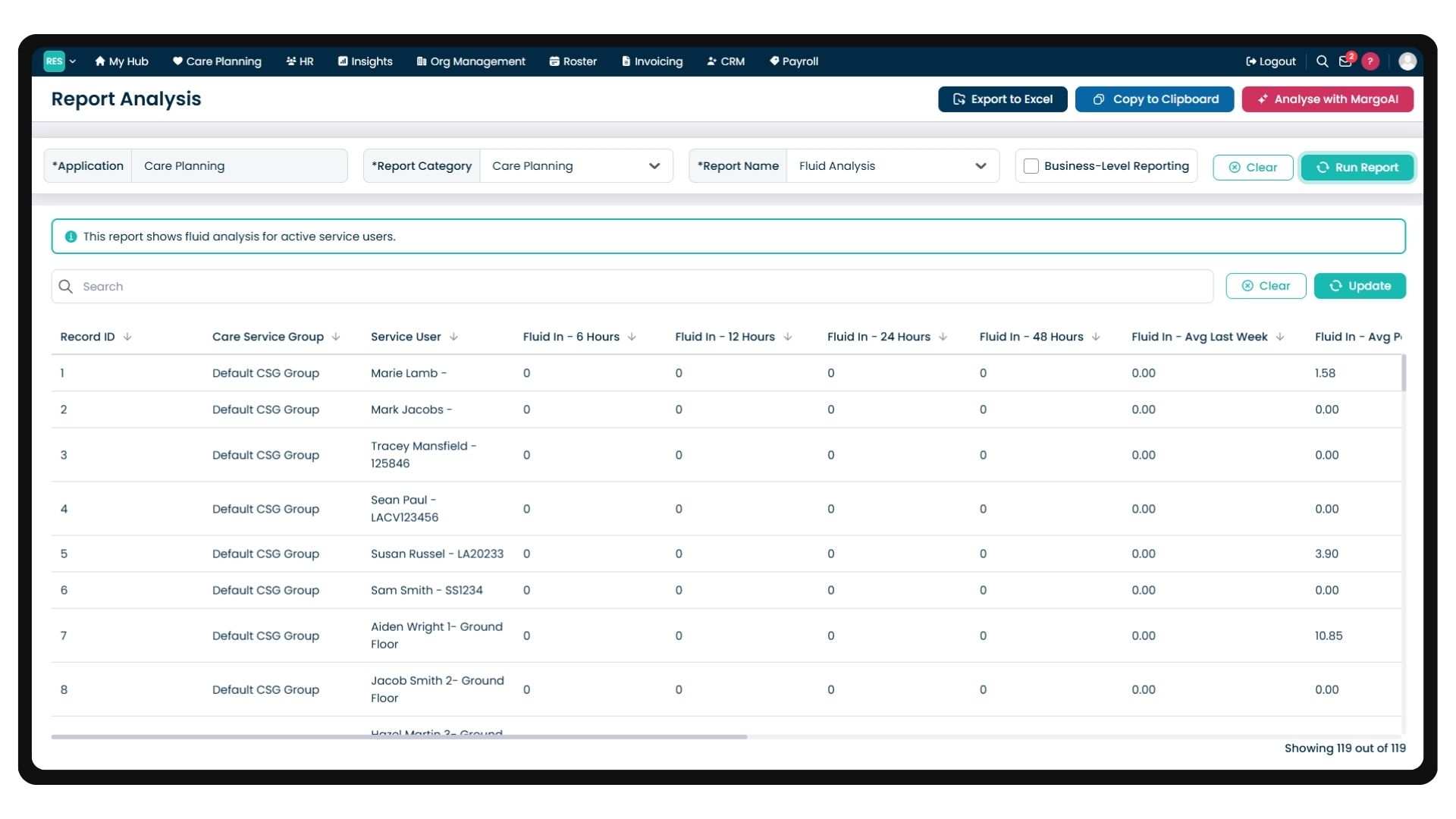
An integrated care management platform allows organisations to view information in context.
Managers can access meaningful insights more quickly, helping them identify opportunities for improvement and respond proactively to challenges.
Rather than spending time compiling reports, teams can focus on interpreting information and taking action.
Why Providers Are Looking Beyond Individual Features
Software purchasing decisions are no longer based solely on features.
Today’s providers are increasingly evaluating how effectively technology supports their wider operational goals.
Questions such as these are becoming more important:
-
Does this platform improve visibility?
-
Will it reduce administration?
-
Can it support future growth?
-
Does it create a single source of truth?
-
Will it simplify compliance processes?
-
Will it help our teams spend more time focused on care?
As these priorities become more prominent, integrated platforms are becoming an attractive alternative to managing multiple disconnected systems.
It’s Not Just About Cost Savings
Reducing software expenditure is often one of the first reasons providers start exploring consolidation.
However, the biggest benefits are often operational.
When information is connected:
-
Managers spend less time searching for information
-
Teams avoid duplicate data entry
-
Reporting becomes easier
-
Staff training is simplified
-
Compliance processes become more efficient
-
Oversight improves across the organisation
The financial savings can be significant, but the impact on day-to-day operations is often even greater.
Providers looking to understand what consolidation could mean for their own organisation can use our Cost Savings Calculator to estimate potential savings from replacing multiple systems with one connected platform.
Looking Ahead
The future of care technology isn’t simply about digitising processes.
It’s about creating connected environments where information flows seamlessly across an organisation.
Providers need systems that support care delivery while helping them manage workforce challenges, compliance requirements and increasing operational pressures.
This is one of the reasons all-in-one care management software continues to gain momentum across the sector.
By bringing care planning, workforce management, compliance and reporting together, providers can reduce complexity, improve oversight and create a stronger foundation for future growth.
As demands on care services continue to increase, many providers are finding that a connected approach helps them spend less time managing software and more time delivering outstanding care.
Want to Learn More?
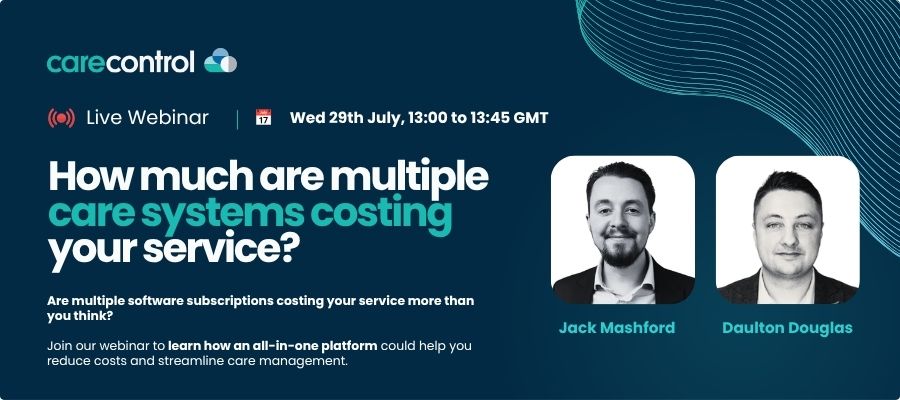
We’re discussing this topic in more detail during our upcoming Lunch & Learn webinar.
Join us as we explore why more providers are moving away from disconnected systems, the benefits of software consolidation and practical steps organisations can take to improve oversight while reducing costs.
👉 Reserve your place here: https://events.teams.microsoft.com/event/0a029c5f-bd60-4e12-9b6c-fcf931de8d8f@1cd19658-a867-47ef-ab86-2361f0ef8f4d
Integrated software brings key operational information together, allowing managers to access accurate data and make informed decisions quicker.
Care Control allows you to reduce the amount of softwares you are using, and therefore you switch between less. Allowing you a centralised space with your Care Planning, Rostering, Payroll, Reporting, HR and eMar rather than having modular applications. With this, your reporting all synchronises and you have oversight across all modules without having to access each part as singular components.
Yes. Consolidating multiple systems can reduce software subscriptions, training requirements, administrative workload and support costs. Reducing costs comes from saving time, and streamlining your applications into one centralised hub for your team. When information is in one space, and you can access everything: with only one subscription payment, you save both time and money.
Why not check our cost calculator and see how many Care Control could save you?
Related Posts